May 15, 2026

If you’ve ever searched online about water quality in Dubai, you’ve almost certainly come across the term TDS. Water filter brands, health bloggers, and concerned parents all talk about TDS levels — but what does it actually mean, what should it be, and how do you test the water in your own home?
This guide covers everything you need to know about TDS in the context of UAE water quality: what it measures, how Dubai’s water compares to global standards, the ideal range for drinking water, and what to do if your TDS readings are outside the healthy zone.
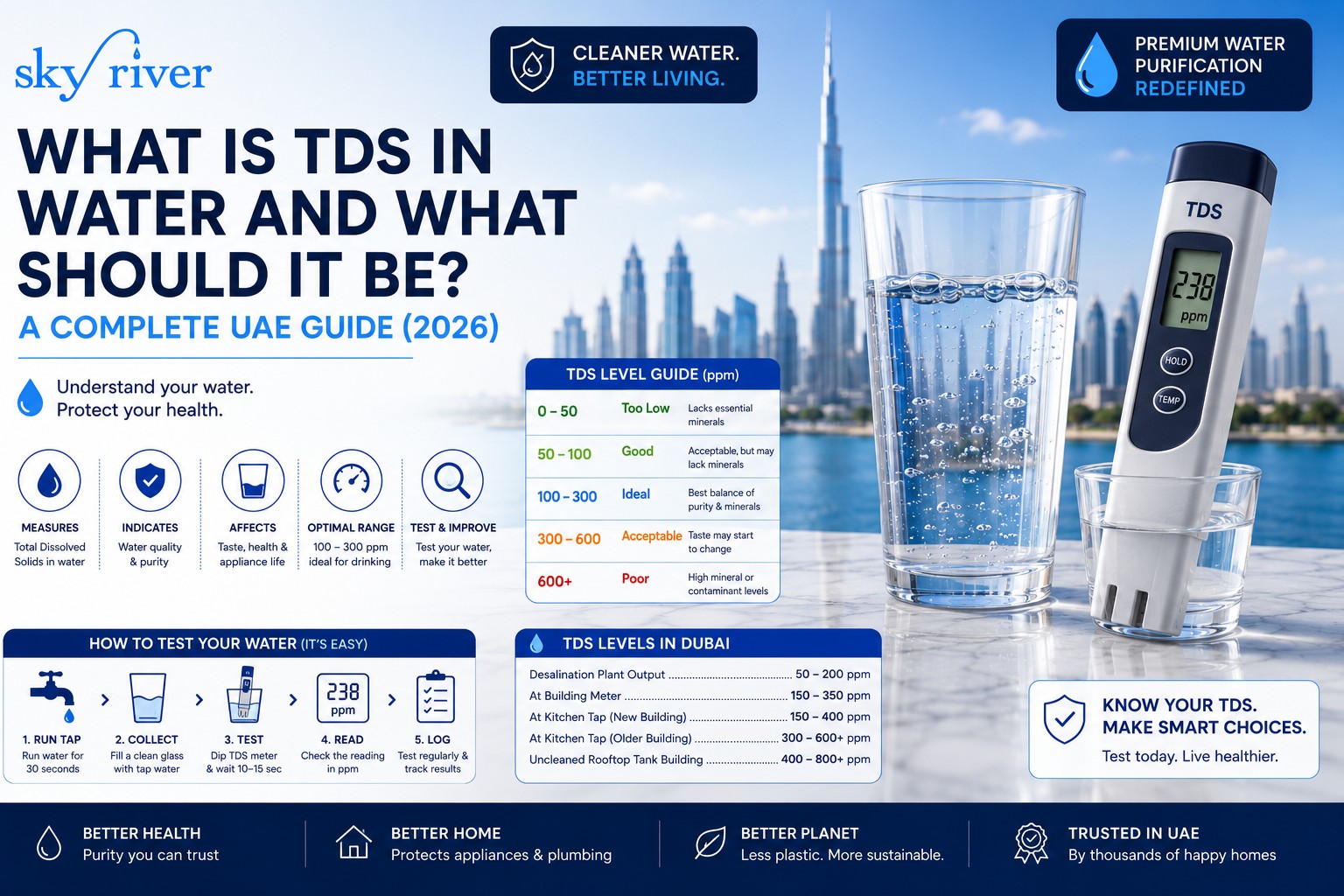
TDS stands for Total Dissolved Solids. It’s a measurement of the combined concentration of all organic and inorganic substances dissolved in water, expressed in milligrams per litre (mg/L) or parts per million (ppm) — these two units are equivalent.
These dissolved substances include:
A TDS reading tells you how much is dissolved in your water — but it doesn’t tell you what is dissolved. A high TDS could mean a lot of beneficial minerals, or it could mean heavy metals and contaminants. This is an important distinction we’ll return to throughout this guide.
TDS is measured using a handheld digital TDS meter — a simple pen-shaped device that you dip into a water sample. The meter measures the electrical conductivity of the water; more dissolved solids means higher conductivity, which translates directly to a TDS reading.
TDS meters are widely available in Dubai and the UAE from Carrefour, Amazon.ae, and electronics shops for between AED 25 and AED 70. They’re easy to use and give an instant reading.
How to test your tap water at home:
Keep a log of your readings over several days. Morning readings (after water has sat in pipes overnight) are typically higher than readings after the tap has been running.
This is where there’s genuine debate in the water quality world. Here’s what the major health authorities recommend:
| Organisation | Recommended TDS Range |
|---|---|
| World Health Organization (WHO) | Below 300 ppm (ideal), up to 600 ppm acceptable |
| US Environmental Protection Agency (EPA) | Below 500 ppm |
| Bureau of Indian Standards | Below 500 ppm |
| European Union drinking water directive | Below 2,500 ppm (aesthetic standard only) |
The WHO’s guidance is the most widely referenced. A TDS of 50–300 ppm is considered ideal for drinking water — clean, well-mineralised, and good-tasting. Between 300 and 600 ppm is acceptable. Above 600 ppm and water typically develops an off taste and raises questions about the source of the elevated reading.
However — and this is critical — low TDS is not automatically better.
Water with a TDS near zero (like pure RO-filtered water with no re-mineralisation) is technically “pure” but lacks the beneficial minerals your body needs. Consistently drinking very low TDS water (below 50 ppm) has been linked to mineral leaching in the body, as the water essentially pulls minerals out of your tissues and bones to equalise its mineral content.
The sweet spot is 100–300 ppm — water that has been purified to remove contaminants but has had minerals like calcium, magnesium, and potassium added back in balanced proportions.
Dubai’s water supply comes from DEWA’s desalination plants. Here are typical TDS levels at different points in the water system:
| Point in System | Typical TDS (ppm) |
|---|---|
| Desalination plant output | 50 – 200 |
| At your building’s water meter | 150 – 350 |
| At your kitchen tap (new building) | 150 – 400 |
| At your kitchen tap (older building) | 300 – 600+ |
| Rooftop tank building (uncleaned) | 400 – 800+ |
If your tap water tests above 400 ppm consistently, the elevated reading is very likely coming from pipe corrosion or an unclean storage tank — not from the original DEWA supply. This is a sign that filtration is warranted.
Not necessarily — but it is a signal worth investigating.
A high TDS reading in UAE tap water most commonly indicates one of these scenarios:
Scenario 1: Pipe corrosion minerals. Older pipes leach iron, copper, zinc, and sometimes lead into the water. These metals are dissolved solids and raise TDS. A reading above 500 ppm from an old building’s tap warrants filtration.
Scenario 2: Unclean rooftop storage tank. If your building stores water in rooftop tanks that haven’t been cleaned recently, bacterial activity and sediment accumulation will raise TDS. More importantly, it raises bacterial risk beyond what TDS alone can capture.
Scenario 3: Natural mineral content. If your area has higher mineral groundwater feeding into the distribution system, TDS may be elevated with harmless minerals. Test with a separate heavy metals test (available at water testing labs in Dubai) to confirm the source.
Scenario 4: Contamination. In rare cases, very high TDS indicates industrial or chemical contamination. If your TDS reading is above 1,000 ppm and you’re not in a known hard water area, professional water testing is recommended.
Generally, yes — but only to a point. Water with a TDS in the 100–250 ppm range tends to taste clean, fresh, and light. Water at the high end (500+ ppm) can taste metallic, flat, or chalky. Water with very low TDS (below 30 ppm, like pure RO water) often tastes flat and “empty” — many people find it unpleasant.
This is why the best water purification systems don’t simply strip all minerals out. They filter water through multiple stages to remove contaminants, then add back a calibrated blend of beneficial minerals (calcium, magnesium, potassium) to restore the ideal mineral balance and pH.
The SkyRiver Toshiba+ Water Purification Dispenser uses a 5-stage filtration process that specifically includes a mineral enrichment and pH balancing stage — delivering water that tests consistently in the 150–250 ppm range with the right mineral profile. This is why it tastes noticeably different from plain filtered water or bottled water.
Here’s a practical guide for UAE residents:
| Your Tap Water TDS | What It Means | What to Do |
|---|---|---|
| 0 – 50 ppm | Over-purified, mineral-poor | Add mineral enrichment filter |
| 50 – 300 ppm | Ideal range | Maintain — consider basic filtration for chlorine/bacteria |
| 300 – 500 ppm | Acceptable but elevated | Recommend multi-stage filtration |
| 500 – 800 ppm | High — investigate source | Multi-stage filtration essential |
| 800 ppm+ | Very high — potential contamination | Professional water test + advanced filtration |
One of the most common misconceptions is that a low TDS reading means the water is safe. This is not true.
A water sample can have a low TDS (say, 150 ppm) and still contain dangerous levels of bacteria, viruses, or specific chemical contaminants that don’t significantly raise the TDS reading. Conversely, water with a TDS of 350 ppm might be perfectly safe if those solids are all beneficial calcium and magnesium.
TDS is a useful indicator but it is not a complete water safety test. For full water safety assurance, you need filtration that addresses:
The SkyRiver filtration range addresses all five of these categories in a single system, purpose-built for UAE water conditions.
The fastest and most effective way to bring your tap water’s TDS into the ideal range — and ensure contaminants are removed — is a quality in-home filtration system:
For drinking and cooking: An under-counter filtration system or freestanding purification dispenser at your kitchen gives you fresh filtered water on demand with ideal TDS, balanced pH, and zero contaminants.
For shower and skin: A shower filter won’t affect TDS measurably but removes chlorine and reduces hardness at the point of use — a major benefit for skin and hair.
For whole-home protection: Our commercial and whole-building solutions treat water before it reaches any tap or appliance in your home — the ultimate solution for families with health sensitivities or investors in high-end properties.
How often should I test my TDS?
Test when you first move into a new property, after any building plumbing work, and every 6 months as a routine check. If you notice a change in your water’s taste or appearance, test immediately.
Do SkyRiver filters reduce TDS?
Yes. Our systems reduce contaminant-related TDS while restoring a healthy mineral balance through the SkyRiver+ mineralisation filter — targeting the 150–250 ppm optimal range.
Can I use a TDS meter to test my SkyRiver filtered water?
Yes — test before and after filtration to see the improvement. Your filtered water should show a reduced TDS reading (contaminants removed) but not a zero reading (minerals retained/added). If your TDS is extremely low after filtration, it may indicate the mineral stage needs attention.
Does bottled water have a better TDS than filtered water?
It depends on the brand. Many bottled water brands sold in UAE have TDS levels between 100 and 400 ppm — some are simply packaged tap water. SkyRiver filtered water consistently achieves a calibrated mineral TDS in the ideal 150–250 ppm range.
Want to know what’s in your water? Get a free water quality consultation from SkyRiver Systems and we’ll help you test, interpret, and address your home or office water quality today.