May 15, 2026

If you’ve moved to Dubai from Europe, North America, or Southeast Asia, you’ve probably noticed something different about the water here within weeks of arriving. Your hair feels drier and harder to manage. Your skin feels tight after showering. There’s a chalky white film on your shower glass, taps, and kettle that reappears no matter how many times you clean it.
That’s hard water — and it’s a daily reality for most residents across Dubai, Abu Dhabi, and the wider UAE.
In this guide we’ll explain exactly what hard water is, how Dubai’s water supply compares to global standards, and most importantly, what the ongoing exposure to hard water is doing to your skin, hair, home, and health.
Water is described as “hard” when it contains a high concentration of dissolved minerals — primarily calcium carbonate and magnesium carbonate. These minerals are picked up naturally as water moves through limestone and chalk rock formations. In the UAE’s case, they’re also introduced during the desalination and re-mineralisation process.
Water hardness is measured in milligrams per litre (mg/L) or parts per million (ppm):
| Hardness Level | mg/L (ppm) |
|---|---|
| Soft | 0 – 60 |
| Moderately hard | 61 – 120 |
| Hard | 121 – 180 |
| Very hard | 180+ |
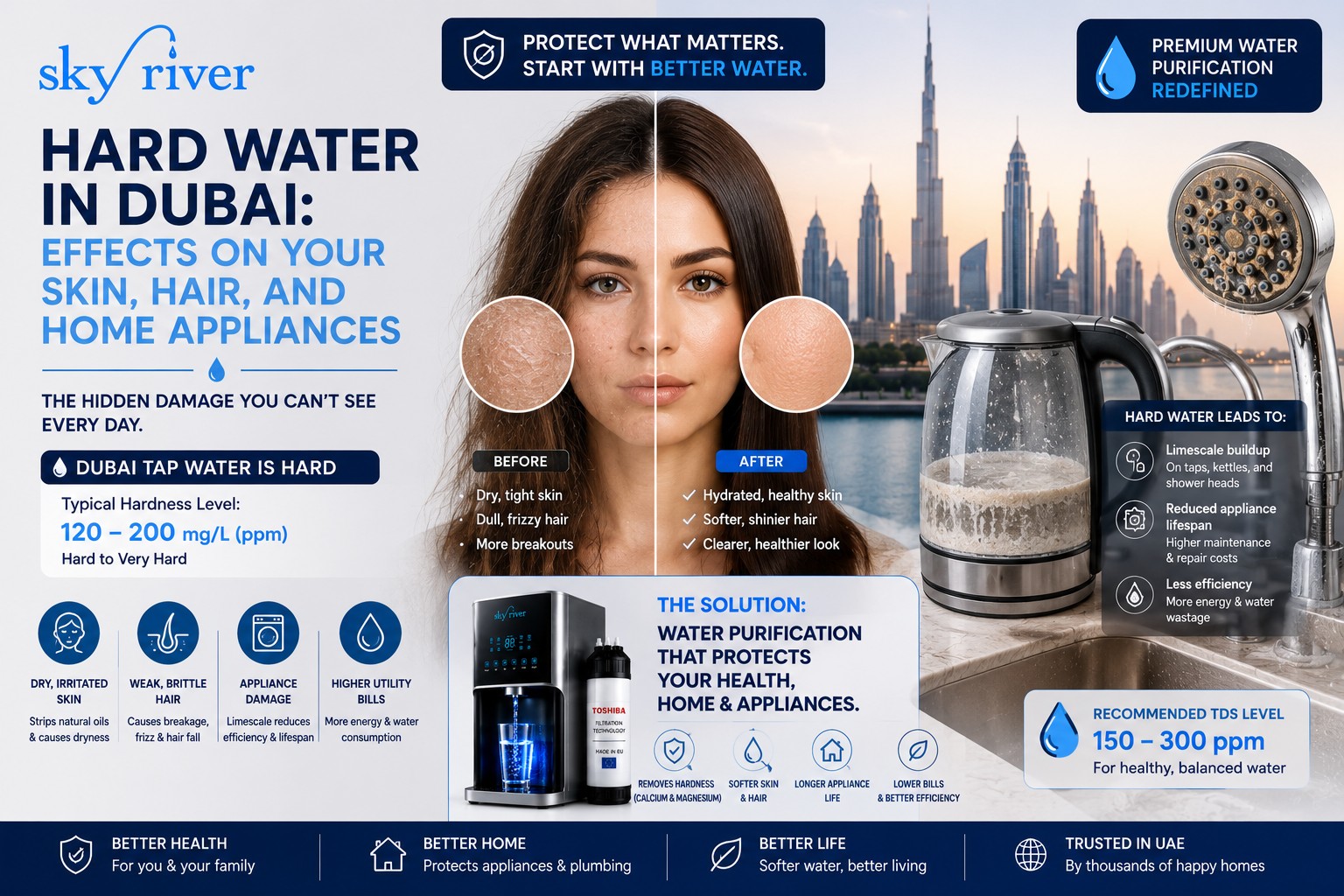
Dubai’s tap water typically measures between 120 and 200 mg/L — falling into the “hard” to “very hard” category depending on your area and building infrastructure. Areas with older pipe networks tend to test higher.
This is where most Dubai residents first notice the problem — in the bathroom.
Hard water reacts with the surfactants (the cleansing agents) in your soap, shower gel, and face wash. Instead of lathering and rinsing cleanly, these products combine with calcium and magnesium ions to form what’s essentially a soap scum — a thin, insoluble film that deposits on your skin as you rinse.
The result? After your shower, you feel like you didn’t fully rinse off. That “squeaky clean” feeling is actually your skin being stripped of moisture and covered with a mineral-chemical film.
Over time and with daily exposure, hard water causes:
Dryness and dehydration: The mineral film disrupts the skin’s natural moisture barrier — the acid mantle — leaving it less able to retain hydration. Skin feels dry, tight, and rough, particularly on the face, hands, and arms.
Eczema and sensitivity flare-ups: Research published in the Journal of Investigative Dermatology found that hard water exposure significantly worsens eczema symptoms in children and sensitive-skinned adults. The mineral deposits irritate already-inflamed skin and interfere with the protective ceramide layer.
Clogged pores and breakouts: The residual soap film and calcium deposits can clog pores, particularly on the face and back, contributing to acne and blackheads in people who weren’t previously prone to them. Many Dubai expats report clear skin in their home country and breakouts within weeks of arrival.
Premature ageing: Ongoing oxidative stress from hard water minerals accelerates skin cell damage. Some dermatologists in Dubai routinely ask about water quality when treating patients with unexplained skin ageing, sensitivity, or persistent dryness.
Install a whole-home or point-of-use shower filter. The SkyRiver shower filter removes calcium and magnesium ions and chlorine at the showerhead, delivering noticeably softer water within days. Most users report that their skin feels better within the first week.
Hair and hard water have a particularly poor relationship.
Your hair shaft has a layered, scale-like outer structure called the cuticle. In soft, balanced water, the cuticle lies flat and smooth, giving hair its shine, softness, and manageability. In hard water, calcium and magnesium ions bind to the hair shaft and cause the cuticle to raise — like scales lifting off a fish.
The effects of this, over weeks and months of daily washing with hard Dubai water:
Dryness and brittleness: The mineral coating prevents moisture from penetrating the hair shaft. Hair feels dry no matter how much conditioner you use — because the conditioner can’t get past the mineral layer.
Dullness: Raised cuticles scatter light rather than reflecting it. Hair loses its natural sheen and looks lifeless and flat.
Tangling and frizz: The rough, raised cuticle texture causes strands to catch on each other. Hair becomes significantly harder to detangle, particularly for people with longer or curly hair.
Colour fading: If you colour or highlight your hair, Dubai’s hard water is stripping your colour faster than it should. Calcium deposits bind to colour molecules and pull them out of the hair shaft with each wash — costing you significantly more frequent salon visits.
Hair loss: This is the concern that sends most people searching for answers. While hard water itself doesn’t directly cause the hair follicle to stop producing hair, the dryness, breakage, and scalp irritation it causes can result in noticeably more hair loss in the shower and on your brush. Many Dubai residents experience increased shedding that resolves when water quality is addressed.
A shower filter at the showerhead removes the primary offenders — calcium, magnesium, and chlorine — before the water hits your hair. You’ll notice softer, more manageable hair within 2–3 washes. A whole-home filtration and softening system offers the most comprehensive solution for families.
Beyond personal health, hard water has a very real financial impact on your home.
Every time you run your kettle, washing machine, dishwasher, water heater, or coffee machine with hard water, calcium and magnesium deposits are building up on heating elements, pipes, and internal surfaces. This limescale is a poor conductor of heat, meaning your appliances work harder and use more electricity to achieve the same output.
Kettle: The white crusty buildup inside your kettle is pure calcium carbonate — the same substance in chalk. Beyond being unpleasant to look at, it flakes off into your hot drinks over time.
Water heater: Limescale coating on your water heater’s heating element can increase energy consumption by up to 25% and significantly shorten the unit’s lifespan. Water heater replacements in Dubai typically cost AED 600–1,500+.
Washing machine: Limescale in your washing machine’s drum and heating element causes premature wear. It also reduces the effectiveness of laundry detergent — requiring you to use more product to achieve the same clean.
Dishwasher: White film on glassware, cutlery, and the inside of the machine itself is classic hard water damage. Glassware becomes permanently etched over time as calcium deposits etch into the glass surface.
Shower screens and taps: The cloudy white film on glass shower screens and around taps is calcium scaling. It requires increasingly aggressive cleaning products — many of which are themselves damaging to surfaces — to remove.
A whole-home water softening and filtration system, installed at your water main, treats water before it reaches any appliance, tap, or showerhead in your home. This eliminates limescale formation throughout the property — protecting your investment in appliances while simultaneously improving water quality for drinking, cooking, and personal care.
The SkyRiver under-counter filtration systems and freestanding water purification dispensers address drinking and cooking water specifically, while our shower filters protect your skin and hair at the point of use.
Not sure if hard water is the culprit? Here’s a checklist of the most common signs:
If you’re ticking more than three of these, hard water is actively affecting your quality of life and your home.
SkyRiver Systems offers a range of filtration and purification solutions designed specifically for UAE water conditions:
All SkyRiver products include free installation, first-year filter set, and lifetime maintenance when you subscribe to our annual filter programme.
Does hard water cause hair loss?
Hard water can cause increased hair breakage and shedding due to mineral coating, dryness, and scalp irritation. It is not a direct cause of clinical hair loss (alopecia), but the symptoms can be dramatic. Many Dubai residents see significant improvement in hair condition after switching to filtered shower water.
Can I use a water softener instead of a filter?
Traditional salt-based water softeners replace calcium and magnesium with sodium ions. While effective for scale removal, sodium-treated water is not ideal for drinking or cooking. A multi-stage filtration system is the better comprehensive solution.
Is hard water safe to drink?
Yes — hard water is not harmful to drink and may even contribute small amounts of beneficial calcium and magnesium. However, very hard water can taste chalky and metallic, and many people prefer the taste and feel of properly filtered and mineralised water.
Does boiling water reduce hardness?
Boiling temporarily reduces some calcium carbonate (you’ll see the scale it leaves in the pot), but it does not soften the water in any meaningful way and does not remove chlorine, bacteria, or heavy metals.
Suffering from dry skin, dull hair, or constant limescale buildup? Let SkyRiver solve your hard water problem. Request a free consultation today and we’ll recommend the right system for your home or office.