May 15, 2026

You’ve done the smart thing — you’ve invested in a water filtration system for your home or office. Clean, purified water on demand, no more plastic jugs, no more worrying about what’s in your tap water.
But here’s the thing most filter owners eventually wonder: when exactly do I need to change the filters? And what actually happens if I leave them too long?
This guide has all the answers — with UAE-specific guidance, because Dubai and Abu Dhabi’s water conditions affect filter lifespan in ways that generic international advice doesn’t account for.
Water filters don’t last forever — they work by physically trapping or chemically neutralising contaminants. Eventually, they reach capacity.
Think of a sediment filter like a sieve: once enough particles have been captured, the sieve clogs and water can no longer flow through at the right rate. Think of an activated carbon filter like a sponge that absorbs chlorine and chemicals: once the carbon sites are fully saturated, it can no longer absorb anything new.
When a filter is past its service life, one of two things happens — or both:
In scenario 2, you may not notice immediately. The water looks the same. But you’ve lost the protection you paid for, and contaminants — chlorine, bacteria, heavy metals, sediment — are passing through unfiltered.
This is why regular filter replacement is not optional. It’s the maintenance that keeps your system doing its job.
Here’s the important local context: Dubai and UAE water conditions are harder on filters than softer water regions in Europe or North America.
High sediment load: The UAE’s distribution network includes ageing pipes in many older buildings. Rust, scale, and sediment particles reduce the lifespan of your first-stage sediment filter more rapidly than in newer infrastructure.
Hard water: Dubai’s hard water contains higher calcium and magnesium concentrations than many international benchmarks. These minerals accumulate on filter membranes and reduce their effectiveness faster.
Higher chlorination: DEWA uses chlorine throughout the distribution network to maintain water safety across long distances. Activated carbon filters in UAE therefore absorb chlorine at a higher rate than they would in cities with shorter distribution distances.
Seasonal temperature variation: UAE’s extreme summer heat can affect water temperature entering the system. Warm water is slightly more aggressive on certain filter media, particularly membranes.
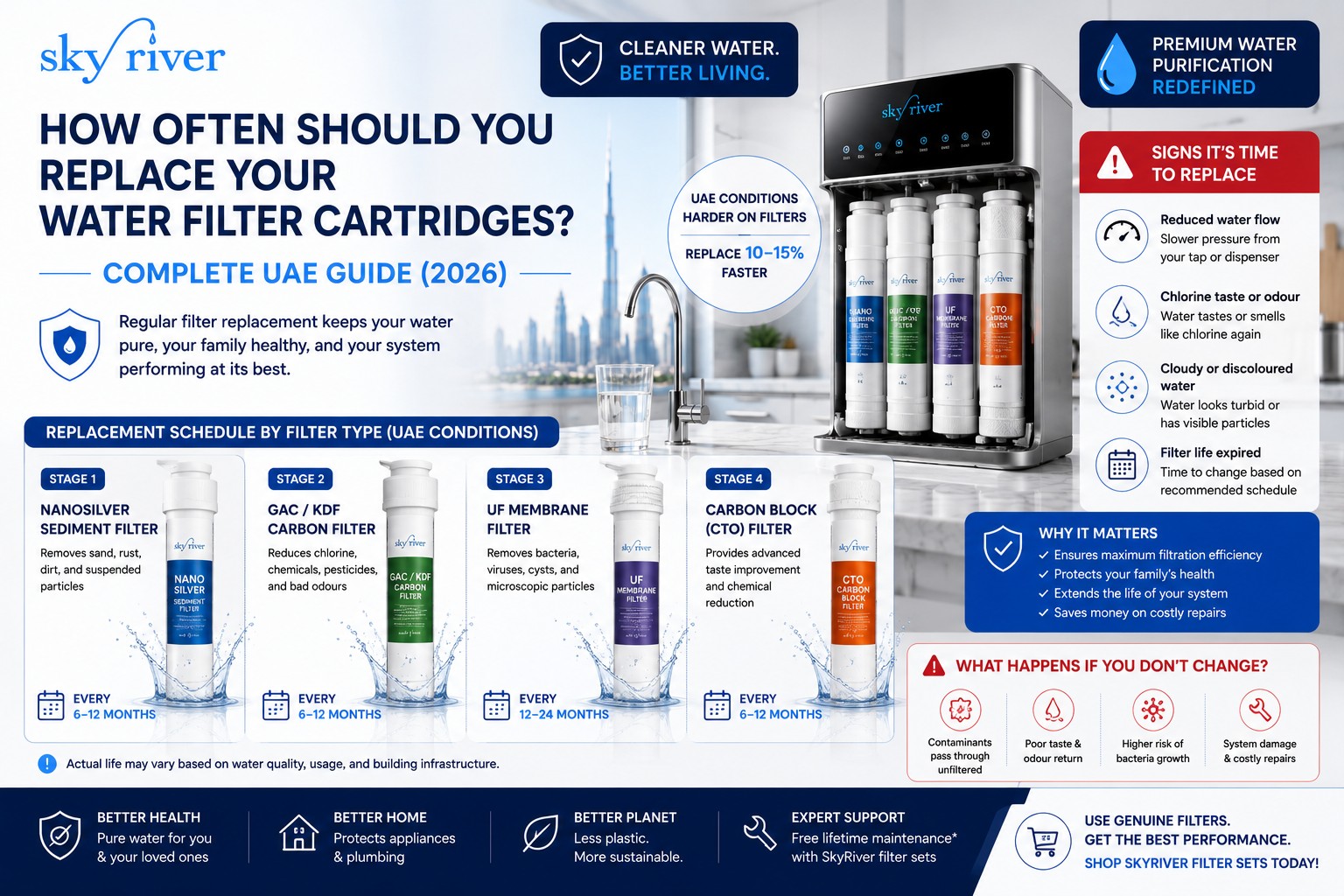
The practical implication: replacement schedules recommended on international packaging may be optimistic for UAE conditions. In our experience servicing thousands of systems across Dubai and Abu Dhabi, UAE households typically reach filter capacity 10–15% faster than the international manufacturer recommendation.
Recommended replacement: Every 6–12 months in UAE
This is your front-line defence — it catches sand, rust, dirt, dust, and suspended particles before they reach the more sensitive stages. In UAE, especially in older buildings, this filter can clog faster than expected.
Signs it needs replacing early: Noticeably reduced water flow from the tap or dispenser. The water may look slightly more turbid. Sediment filter cartridges are often discoloured (brown or orange from rust) — you can visually inspect them without specialist tools.
SkyRiver note: Our NanoSilver sediment filter uses silver nanoparticles that provide additional antimicrobial action, extending effectiveness between changes.
Recommended replacement: Every 6–12 months in UAE
This stage removes chlorine, chloramines, pesticides, herbicides, VOCs, and many organic chemicals that affect taste and smell. Activated carbon works by adsorption — contaminants stick to the enormous internal surface area of the carbon particles. Once those sites are full, the filter is exhausted.
Signs it needs replacing: Water starts to taste or smell of chlorine again. If you notice the water smells “flat” or like a swimming pool after it used to taste clean, your carbon stage is overdue.
In UAE, where chlorine is used heavily throughout the distribution network, this filter often exhausts before the 12-month mark in high-usage households.
Recommended replacement: Every 12–24 months
The UF membrane is the most critical protection stage — it removes bacteria, viruses, cysts, and microscopic particles down to 0.01 microns. Unlike sediment and carbon filters, UF membranes can often be backwashed (reversed) to extend their service life.
Signs it needs replacing: Reduced flow rate that doesn’t improve with backwashing. In some systems, a turbidity test can confirm membrane degradation.
Recommended replacement: Every 6–12 months
The carbon block provides a second level of chemical and chlorine reduction, acting as a polishing stage after the sediment and GAC stages. It also improves taste and odour.
Signs it needs replacing: Similar to the GAC stage — return of chlorine taste or odour. Reduced water flow.
Recommended replacement: Every 12 months
The mineral filter adds back calcium, magnesium, and potassium ions and raises the water pH to the optimal 7.5–8.5 range. Over time, the mineral media depletes and the beneficial effect diminishes.
Signs it needs replacing: If you test your water TDS and find the mineral reading has dropped close to zero, the mineralisation stage is exhausted. Water may also taste flat or slightly acidic.
Recommended replacement: Every 12 months
UV lamps lose intensity over time even when they appear to be working. At reduced intensity, the UV dose is insufficient to reliably deactivate all bacteria and viruses. Replace annually regardless of apparent function.
| Filter Stage | UAE Replacement Frequency |
|---|---|
| Sediment / NanoSilver | Every 6–12 months |
| Granular Activated Carbon (GAC) | Every 6–12 months |
| Ultrafiltration (UF) Membrane | Every 12–24 months |
| Carbon Block (CTO) | Every 6–12 months |
| Mineral Enrichment (SkyRiver+) | Every 12 months |
| UV Sterilisation Lamp | Every 12 months |
For most SkyRiver system owners, the practical answer is to purchase an annual filter replacement set — which includes all the cartridges due for change at the 12-month mark in a single pre-packaged kit. This is simpler, more cost-effective than buying filters individually, and ensures no stage is accidentally overlooked.
This is the most important question — and the honest answer is more serious than most people realise.
Bacterial growth: A clogged sediment filter can become a breeding ground for bacteria. The particles trapped in the filter provide nutrients; the moist environment provides perfect conditions. Over time, bacteria can colonise the filter media and begin to pass downstream into your drinking water — the exact opposite of what the filter is supposed to do.
Contaminant breakthrough: An exhausted activated carbon filter stops removing chlorine and chemicals. An overloaded UF membrane develops microscopic tears that allow bacteria and viruses to pass. You’re now drinking what you think is filtered water, but the filtration is not working.
System damage: In some cases, a severely clogged sediment filter can cause pressure problems that stress the downstream membrane stages, potentially causing damage that requires expensive component replacement.
Voided warranty: Many manufacturers and service providers void warranties if the system is run beyond the recommended filter replacement intervals. SkyRiver’s free lifetime maintenance programme is conditional on maintaining your annual filter set purchases — which is why we send reminders and make it as easy as possible.
We designed our filter replacement programme to remove all the friction:
No guesswork, no missed stages, no searching for compatible cartridges. Just clean water, every day.
Can I extend my filter life by using less water?
Filter life is determined by volume of water filtered AND time elapsed. Even in low-usage situations, filters should be replaced on schedule because bacterial colonisation and media degradation happen over time regardless of water volume.
Is it safe to replace my own filters?
Yes — SkyRiver filter cartridges use a simple twist-change design. However, our annual service programme includes a free technician visit, so there’s rarely a reason to do it yourself unless you prefer to.
How do I know which filter set fits my SkyRiver system?
Each SkyRiver system model has a corresponding filter set. Check the product name on your system or contact us and we’ll identify the right kit for you.
What if I want to replace filters more frequently — is that safe?
Absolutely — more frequent replacement only improves water quality. If you live in an older building with high sediment, or if you have a large household, replacing the sediment and carbon stages every 6 months rather than 12 is a sensible choice.
Do SkyRiver filters work with other brands?
SkyRiver filter sets are designed and calibrated specifically for SkyRiver systems to ensure the correct flow rates, contact times, and filtration performance. We recommend using only genuine SkyRiver replacement filters.
Due for a filter change — or not sure when it’s due? Contact SkyRiver Systems and we’ll check your service history and schedule your maintenance visit at no charge.