May 15, 2026

What if your drinking water could come not from a tap, a pipe, or a plastic bottle — but from the air around you?
It sounds like science fiction, but atmospheric water generation is a real, proven technology that’s been growing rapidly in relevance — particularly in regions like the UAE where water scarcity, extreme heat, and heavy reliance on energy-intensive desalination are ongoing challenges.
In this guide we explain exactly how atmospheric water generators (AWGs) work, why the UAE is one of the best environments in the world to use them, and who they’re designed for.
An atmospheric water generator — or AWG — is a device that extracts water vapour from the surrounding air and converts it into clean, drinkable water. It does this through a cooling and condensation process, similar to the way a cold glass of water “sweats” on a humid day, or the way a dehumidifier extracts moisture from a room.
The key difference between a standard dehumidifier and an AWG is what happens to the water collected. An AWG doesn’t just extract moisture — it passes it through a multi-stage filtration and purification system before dispensing it as drinking-quality water.
The result is water that is genuinely independent from the mains water supply. No pipes, no delivery trucks, no plastic bottles. Water, literally from the air.
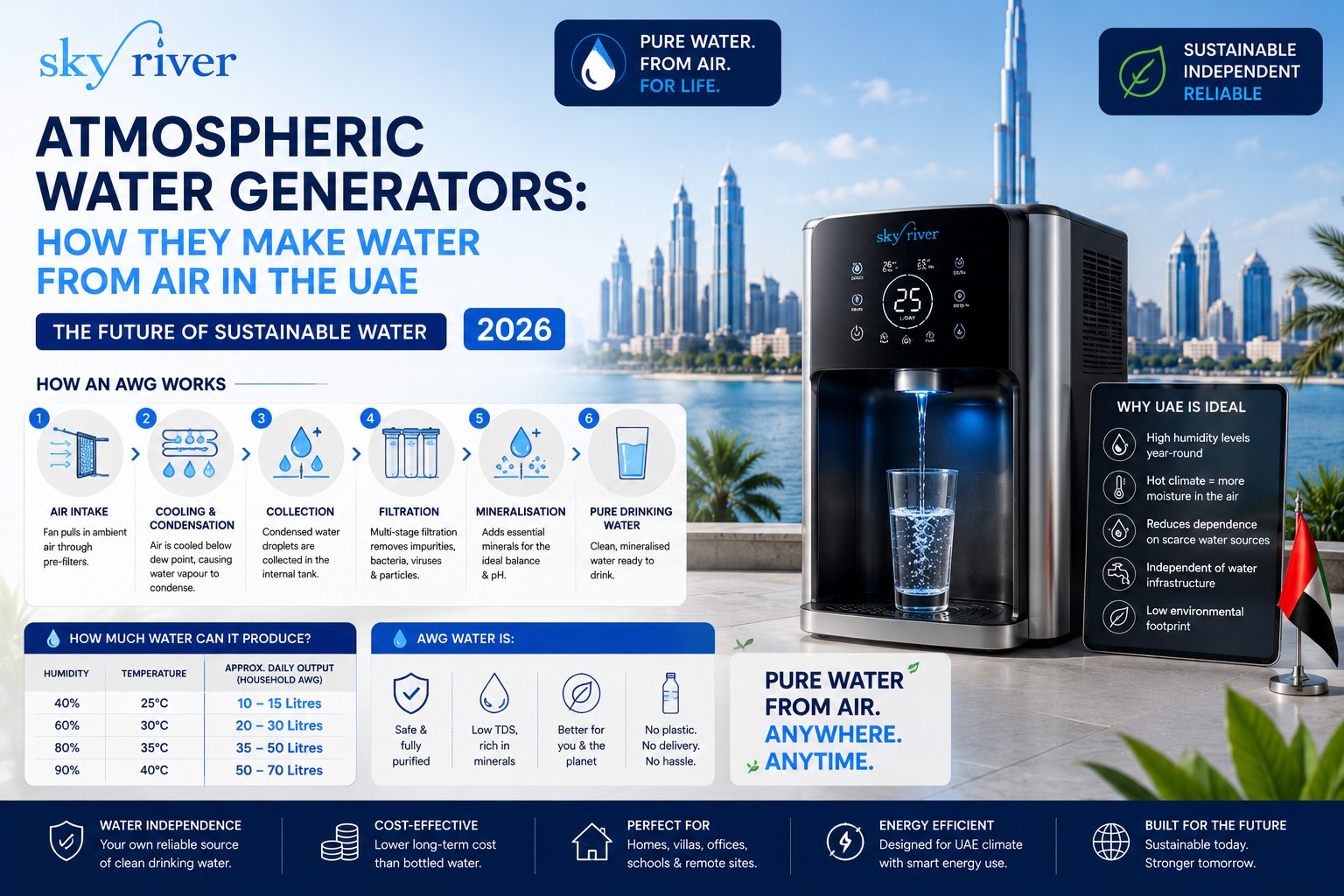
Here’s the condensation-to-glass process:
Step 1 — Air intake: A fan draws ambient air into the AWG unit through a pre-filter that removes dust, pollen, and airborne particles before processing begins.
Step 2 — Cooling and condensation: The air passes over refrigerated cooling coils (similar to those in an air conditioning unit). As the air cools below its dew point, water vapour condenses into liquid droplets — the same physical process that creates morning dew on grass.
Step 3 — Collection: The condensed water droplets are collected in an internal reservoir.
Step 4 — Multi-stage filtration: The collected water passes through multiple filtration stages — typically including sediment filtration, activated carbon treatment, and an ultrafiltration or UV sterilisation stage — to ensure it’s free from bacteria, viruses, and chemical traces.
Step 5 — Mineralisation: Pure condensed water has very low TDS (similar to distilled water). Most quality AWGs include a mineral enrichment stage that adds calcium, magnesium, and other beneficial minerals to achieve the ideal mineral profile and pH for drinking.
Step 6 — Dispensing: The finished water is stored in an internal tank and dispensed on demand — typically at ambient, chilled, and hot temperatures, just like a conventional water dispenser.
You might expect that atmospheric water generation would work best in places like tropical rainforests with very high humidity. In fact, modern AWG technology is well-suited to UAE conditions — and for several reasons:
High ambient humidity: The UAE, particularly coastal cities like Dubai, Abu Dhabi, Sharjah, and Ras Al Khaimah, experiences significant humidity — often 60–90% during summer months, and 40–60% through much of the year. This humidity is the raw material for AWG production. More moisture in the air means higher water output.
Hot temperatures: Warm air holds more water vapour. UAE’s consistently warm climate means the air is dense with moisture even in the cooler months — contributing to reliable water production year-round.
No infrastructure dependency: AWGs operate completely independently of the mains water supply. For remote sites, construction projects, desert locations, island properties, or emergency situations, this independence is invaluable.
Water scarcity context: The UAE is among the world’s most water-scarce nations. The country produces the vast majority of its drinking water through energy-intensive desalination. AWG technology offers a decentralised, lower-infrastructure alternative for supplementing drinking water supply.
Sustainability credentials: Compared to bottled water (with its plastic waste and carbon-intensive logistics) and even piped water (which requires enormous infrastructure and energy input), an AWG connected to renewable energy has an exceptionally low environmental footprint.
Water production depends on ambient temperature and humidity. Here are approximate output figures under typical UAE conditions:
| Humidity | Temperature | Approximate Daily Output (household AWG) |
|---|---|---|
| 40% | 25°C | 10 – 15 litres |
| 60% | 30°C | 20 – 30 litres |
| 80% | 35°C | 35 – 50 litres |
| 90% | 40°C | 50 – 70 litres |
During UAE summer months — when temperature and humidity are both at their peak — a residential AWG can comfortably supply the drinking water needs of a family of 4–6 people. During cooler winter months (October–February), output decreases but remains viable for supplemental drinking water.
Commercial and industrial AWG units can produce hundreds to thousands of litres per day, making them suitable for hotels, large offices, construction sites, and emergency relief operations.
Yes — when produced and filtered correctly, atmospheric water is among the cleanest water you can drink.
Atmospheric water starts as water vapour, which means it has naturally left behind ground contaminants, pipe sediment, chlorine treatments, and most chemical pollutants. It’s essentially rain, before it hits the ground.
The multi-stage filtration system then removes any airborne contaminants that may have been collected during the condensation process, sterilises the water, and adds back beneficial minerals before it reaches your glass.
The quality of AWG water is ultimately a function of the quality of the filtration system — which is why SkyRiver’s atmospheric water generators use the same EU-made filtration technology as our entire product range, tested and certified to deliver consistently clean, mineral-rich drinking water.
AWGs are not the right solution for everyone — they have specific advantages over conventional filtration that are most relevant in particular contexts.
You’re well-suited for an AWG if:
Remote or off-grid locations: Farms, desert retreats, island properties, or any location where the mains water supply is unreliable, of poor quality, or simply not connected.
Construction and temporary sites: Building sites, oil and gas operations, and temporary work camps often lack reliable water infrastructure. AWGs provide clean drinking water without delivery logistics.
Emergency preparedness: AWGs provide water supply independence in the event of pipe network failures, water quality incidents, or supply disruptions. The 2020 COVID-19 period highlighted how supply chain disruptions can affect even basic necessities.
High-end residential and hospitality: For properties where premium water quality and complete supply independence are priorities — luxury villas, boutique hotels, eco-resorts — an AWG is a compelling statement of sustainability and self-sufficiency.
Businesses committed to zero plastic: Offices, restaurants, and commercial facilities looking to eliminate bottled water entirely from their operations. An AWG removes the last dependence on bottled or delivered water.
Sustainability-focused organisations: Companies with environmental commitments, green building certifications (LEED, Estidama), or corporate sustainability targets benefit from the zero-plastic, low-infrastructure footprint of AWG technology.
You might prefer conventional filtration if:
You’re in a well-connected urban home or apartment with reliable mains water supply. In this case, an under-counter or freestanding filtration system (like the SkyRiver Toshiba+ or SkyRiver WAVE under-counter system) achieves excellent water quality at a lower entry cost, and is the more practical choice for most Dubai residential users.
| Factor | AWG | Conventional Filter |
|---|---|---|
| Water source | Air (humidity) | Mains tap water |
| Infrastructure | None required | Requires pipe connection |
| Output per day | 15–70L (residential) | Unlimited (mains pressure) |
| Best for | Remote sites, off-grid, B2B | Urban homes, offices |
| Running cost | Electricity only | Electricity + filter replacements |
| Installation | Plug-and-play | Plumbing connection |
| Plastic waste | Zero | Zero |
| Water independence | Complete | Dependent on mains supply |
In a country where water scarcity is a genuine national security concern, AWG technology aligns directly with the UAE’s sustainability goals, including the UAE Net Zero 2050 strategy and Dubai’s Clean Energy Strategy.
Every litre of water produced by an AWG is a litre that doesn’t require desalination energy, distribution infrastructure, or plastic packaging. When paired with solar power — readily available in the UAE’s solar-ideal climate — an AWG can produce water with a near-zero carbon footprint.
This is why AWG technology is being adopted at scale by UAE government projects, EXPO-linked sustainability initiatives, and forward-thinking businesses that understand that water self-sufficiency is not just environmentally responsible — it’s strategically smart.
SkyRiver Systems is one of the UAE’s leading suppliers of atmospheric water generators, with installations across residential, commercial, and industrial settings throughout Dubai and Abu Dhabi.
Our AWG range offers:
View our full AWG range or contact our team for a site assessment and consultation.
Does an AWG work indoors or outdoors?
Both. Residential units are typically placed indoors where air conditioning may reduce humidity — though most modern AWGs are efficient enough to work well in air-conditioned spaces. Commercial and industrial units often operate outdoors where ambient humidity is higher.
How much electricity does an AWG use?
Energy consumption varies by model and output. A typical residential AWG producing 20–30 litres per day uses approximately 1.5–2 kWh of electricity daily — comparable to a standard water dispenser. Commercial units with higher output consume more.
Is AWG water the same as distilled water?
No. Distilled water has had all minerals removed and typically has a flat taste and very low TDS. AWG water is condensed, filtered, and then re-mineralised — giving it a balanced mineral profile and natural fresh taste.
Does an AWG need a water connection?
No — this is the key advantage. An AWG requires only a power supply (standard electrical connection). No plumbing connection is required.
Can an AWG work in a dry climate or low humidity?
Most AWG units require a minimum humidity of around 35–40% to operate. In the UAE, coastal and urban areas consistently exceed this threshold. In extremely arid inland desert locations, output may be limited.
Interested in atmospheric water generation for your property, business, or project? Contact SkyRiver Systems for a free site assessment. We’ll evaluate your location, humidity profile, and water needs to recommend the right AWG capacity for you.